Fake Gamers, Real Workers
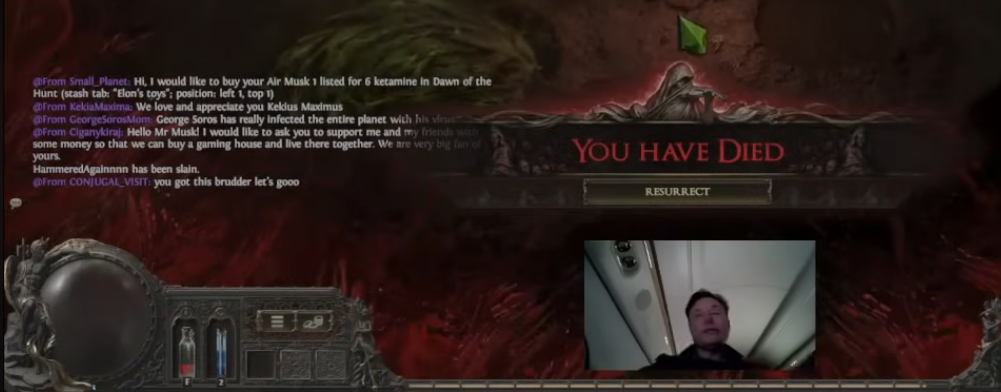
In the first week of 2025—a time that, like much of recent memory, simultaneously feels years ago and yesterday—Elon Musk was once again getting ratioed on his own social media platform. Not because he had reposted Nazi propaganda or misgendered his own daughter—this was an act far more egregious: he was really, embarrassingly bad at a video game. On the 7th of January Elon booted up his computer and began live-streaming himself playing Path of Exile 2. Since the game’s launch in late 2024 Musk had repeatedly been claiming to be one of its highest ranked hardcore players. This was almost immediately called into question as it became clear he had no clue what he was doing. Over the course of the 90-odd minute stream Elon repeatedly attempted to click on inaccessible parts of the screen, walked blissfully unaware past valuable loot, and seemed to have no idea about how the games various levelling systems worked.
Even before the stream ended, speculation was already swirling (and would later be confirmed) that he had boosted his character: a practice in multiplayer online games wherein a novice player employs other, more skilled players to play as their digital avatar and level their account in order to boost its standing. Boosting provides the account’s owner with the prestige of skill without having to do any of the troublesome work honing it themselves. The technological abstraction inherent to video games smoothly enables this facade of skill. A program does not care who presses its buttons, it just knows what to do once they are pressed. Consequently, a virtual character could have any number of pilots, and it would be almost impossible for an outside observer to know unless its least skilled operator decided to live-stream themselves dying to the tutorial boss.
Elon’s bizarre attempt at gaming left a wake of gossip and confusion. Why on earth would Elon even bother doing this? Why does the richest man in the world want so badly to be seen as a Gamer? Why would a billionaire think it was a good idea to take credit for the skilled labour of others? The exploitation of technological abstraction to mask fraud and harvest capital is far from novel: Elon is simply the latest in a long line of capitalists, entrepreneurs and hucksters who have enriched themselves by using the veneer of complexity and abstraction provided by technology to hide the reality that their ‘innovation’ is simply someone else doing the job.
In 1770, Wolfgang von Kemplen unveiled his latest invention to Maria Theresa, the Empress of Austria. He had created an automaton that was capable of playing a game of chess against a human opponent; an act of complexity that far outshone other automata of the era. ‘The Mechanical Turk’ went on to tour the world, playing games against grand-masters and celebrities alike, until it was destroyed by a fire in the mid 1800s. It was only then that its inner workings were publicly revealed: every move the Turk made was, in actuality, conducted by a human hidden behind its cogs and gears. It was, perhaps, the first fake gamer.
Kempelen’s wondrous leap forward in automation was simply human labour which had been abstracted into perceived automation. Much of the convoluted clockwork inside the Mechanical Turk was superfluous, yet this facade was crucial to the function of the con. Were the automaton to have been stripped of its veneer and its true mechanics laid bare, its capital (social and financial) would vanish as rapidly as it was created. Transmuted by a series of cogs and levers, the actions of a human chess player became more incredible, more marvelous, more valuable. This speculative value appeared from the perceived ownership of skill removed entirely from humanity and placed within a tangible asset; the Mechanical Turk called toward a world in which skill could be attained through purchase rather than practice.
Much like Elon’s Path of Exile account, the Mechanical Turk had many skilled operators over the course of its life. Although some of them are known (William Schlumberger, Jacques François Mouret, and Aaron Alexandre to name a few), the majority of its operators have been largely forgotten by history, hidden again in the shadows cast by the machine and eaten by the ego of its owner. For both Kemplen and Musk their pretense of accomplishment was held together by the facade of a machine that hid an anonymous worker who possessed the actual skill the two men desired.